The Multi-Drug Regimen Most Finasteride Users Never Audit
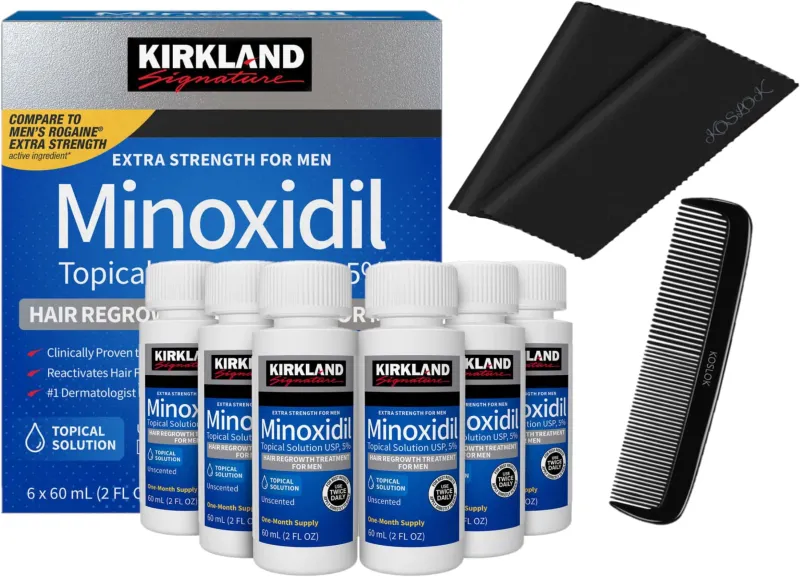
Photo: minoxidil foam and ketoconazole shampoo bottles bathroom shelf, via m.media-amazon.com
Finasteride is often described as the anchor of a hair-loss regimen, but in practice many men are running a larger stack: a daily pill, a topical minoxidil solution or foam, a ketoconazole shampoo, perhaps an oral minoxidil prescription from a telehealth clinician. The combination is common enough that it has become a de facto standard in some online communities. The clinical question is whether each addition earns its place.
Why combinations get used
The rationale is mechanistic. Finasteride reduces conversion of testosterone to DHT by inhibiting type II 5-alpha reductase, which slows follicular miniaturization. Topical minoxidil prolongs the growth phase and may improve perifollicular blood flow. Ketoconazole shampoo has antifungal and anti-inflammatory effects and may modestly reduce local androgen signaling. Because these agents act through different pathways, combining them is biologically plausible.
Plausibility is not the same as proven superiority. A combination can be rational and still be unnecessary for a given patient. The relevant questions are whether the added agent has randomized evidence in androgenetic alopecia, whether the effect is clinically meaningful, and whether the patient can sustain the routine and cost.
Finasteride plus topical minoxidil
This is the best-studied combination in male pattern hair loss. Oral finasteride and topical minoxidil are both FDA-approved for androgenetic alopecia, and multiple randomized trials and meta-analyses have found combination therapy superior to either agent alone on hair count or investigator assessment. The effect sizes vary, and not every trial agrees on the magnitude of benefit, but the direction of evidence is consistent enough that the combination is a mainstream dermatologic option.
The practical caveat is adherence. Topical minoxidil requires twice-daily application for most formulations, and real-world persistence is poor. A combination that works in a twelve-month trial but is abandoned at month four is not superior to finasteride alone. Men who dislike topical products, have scalp sensitivity, or travel frequently may get more value from consistent finasteride monotherapy than from an ambitious regimen they cannot maintain.
Oral minoxidil: convenience with monitoring
Low-dose oral minoxidil has become more common in US dermatology practices as an off-label option for hair loss. It appeals to patients who want to avoid topical residue and application burden, and some clinicians use it when topical minoxidil has failed or irritated the scalp. The evidence base is growing but remains less mature than the evidence for topical minoxidil.
Adding oral minoxidil to finasteride is not a casual decision. Oral minoxidil can cause fluid retention, tachycardia, dizziness, and unwanted hair growth on the face or body. It requires a clinician comfortable with dosing and monitoring, especially in men with cardiovascular disease or uncontrolled hypertension. It is not a supplement, and it should not be self-sourced from overseas pharmacies.
Ketoconazole shampoo
Ketoconazole shampoo is available over the counter at 1% and by prescription at 2% in the US. It is not a hair-growth drug in the way finasteride or minoxidil is, but some trials suggest that regular use can improve hair density and reduce scalp inflammation in men with androgenetic alopecia, particularly as an adjunct. The effect is modest and the evidence is less robust than the evidence for finasteride plus minoxidil.
The main risks are dryness and irritation, especially with frequent use. A reasonable approach is two to three applications per week, with a moisturizing conditioner as needed. Patients should not expect ketoconazole to compensate for inconsistent use of finasteride or minoxidil.
When monotherapy is enough
Finasteride alone is a reasonable regimen for men with early to moderate androgenetic alopecia who are stable, tolerate the drug, and prefer simplicity. Monotherapy is also appropriate when the diagnosis is uncertain, when the patient has not yet established a baseline, or when cost and adherence are major constraints.
A useful rule is to change one variable at a time. Adding three products simultaneously makes it impossible to know which one is responsible for benefit or side effects. Baseline photographs, a consistent lighting setup, and a six- to twelve-month review are more valuable than an elaborate stack that is never audited.
A practical decision framework
First, confirm the diagnosis. Not all hair loss is androgenetic, and combination therapy will not fix telogen effluvium, thyroid disease, iron deficiency, or scarring alopecia. Second, define the goal: stabilization, regrowth, or coverage before a transplant. Third, assess the patient's tolerance for topical products, cost, and daily routine. Fourth, add one agent at a time and track outcomes with photographs and, when appropriate, scalp density measurements.
Bottom line
The strongest combination evidence supports finasteride plus topical minoxidil in men who can adhere to both. Ketoconazole shampoo is a reasonable adjunct with modest evidence. Oral minoxidil is a clinician-led option for selected patients, not a default add-on. Monotherapy remains defensible when finasteride is working, tolerated, and sustainable. The best regimen is not the longest one; it is the one the patient can follow and the clinician can evaluate.